PONS Football Ecosystem
The PONS Ecosystem: Architecture for Resilience
How the PONS ecosystem integrates methodology and technology to achieve maximum adaptability.
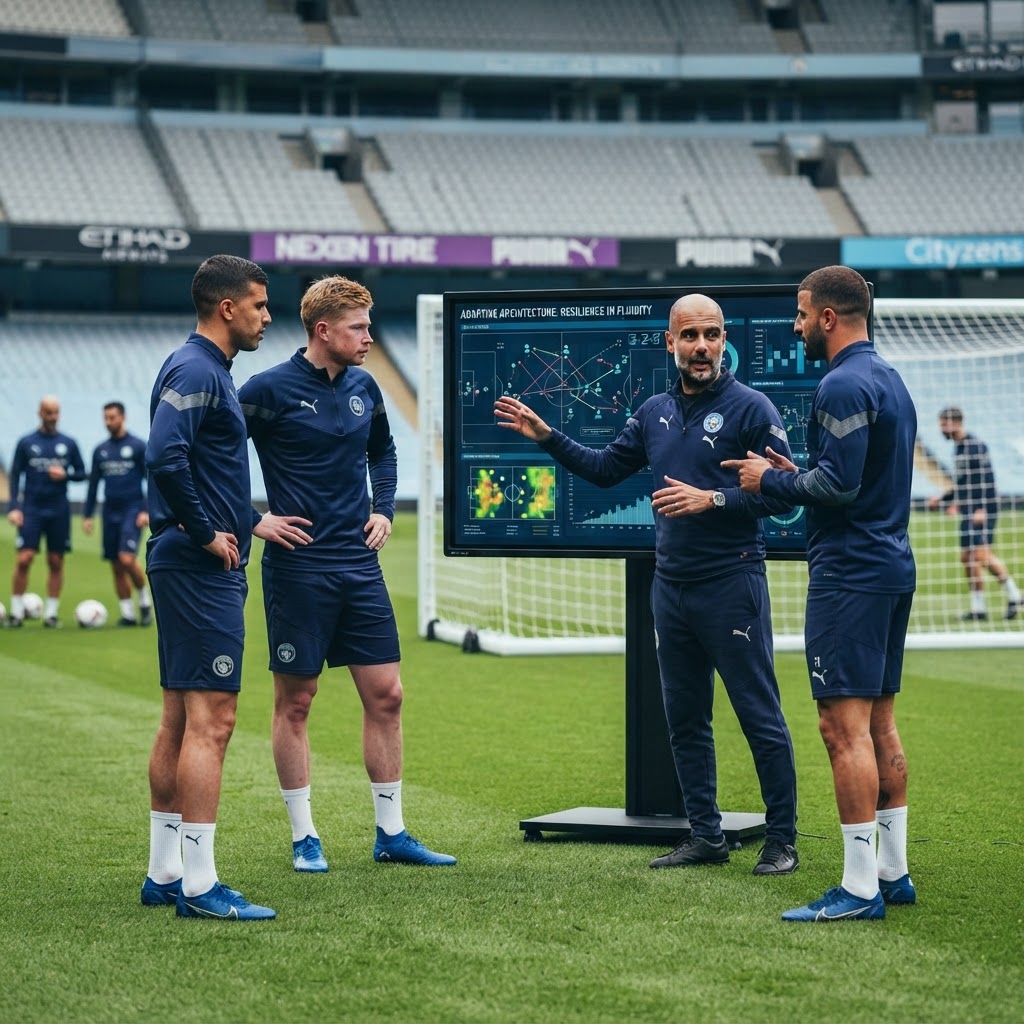
Within the PONS Football ecosystem, this idea connects training, methodology, operational tools, and club implementation within the same path of football intelligence. In contemporary football, predictability is a fleeting illusion. The central thesis is that true mastery lies not in eliminating uncertainty, but in building an architecture of resilience that allows teams to thrive in the face of the unexpected. Rigid tactical models, however sophisticated they may be, crumble under the pressure of an adaptive opponent, an unforeseen injury, or a drastic climate change. The key is not to memorize scripts, but to cultivate the ability to react, reorganize, and rethink in real time. The development of this resilience is based on the cognitive architecture of the player and the collective. This implies training not only the 'what' to do, but the 'how' to think under pressure. A resilient footballer is one capable of quickly evaluating new variables, identifying emerging patterns, and making optimal decisions within increasingly narrow windows of time. Training must consistently simulate scenarios of controlled disorder, forcing players to exercise their autonomy and develop confidence in their ability to adapt. This goes beyond simple repetition; it requires the creation of environments where decision-making is the primary engine of improvement. The practical implication is clear: training methodologies must prioritize the development of mental agility and tactical plasticity. Coaches must design sessions that foster the exploration of solutions, effective communication in adversity, and the acceptance of error as an intrinsic part of the learning process. By building this 'architecture of resilience', teams not only survive uncertainty, but turn it into a competitive advantage, anticipating and adapting to the changing demands of the game. Fluidity and responsiveness are the new standard of football excellence. The goal is not another isolated product: it is a continuous loop from learning to application, verification, and institutional scale.
Continue learning through the most relevant PONS route